Standard Service – 3-4 Business Days
Expedited Service – 1 Business Day
Last Updated 2/9/2026 at 11:31AM

At InjectorRx, we believe that understanding your fuel injection system is the first step to better engine performance. Whether you’re a DIY enthusiast, a professional mechanic, or simply curious about how your engine works, our Education Center offers expert resources to fuel your knowledge. Below, you’ll find detailed subpages that break down essential topics—including how fuel injectors work, types of injectors, maintenance best practices, and fuel injection system components. Each section is designed to help you make informed decisions about injector service, performance tuning, and overall engine care. Explore the links below to learn more and keep your engine running at peak efficiency.
Calculate fuel flow like a pro. Use our helpful injector calculators to determine flow rates at various pressures, convert manufacturer specs (like MPa and g/s) to usable data, and fine-tune your engine setup with confidence.
Keep your injectors running like new. Learn why regular injector cleaning is essential for engine health. Discover the pros and cons of fuel additives, and why professional ultrasonic cleaning and flow testing offer unmatched reliability when problems arise.
Access trusted injector specifications. This searchable database provides manufacturer data used to verify injector performance during service. Compare flow rates, pressures, and other technical specs to ensure your injectors meet OEM standards.
Understand how engines manage fuel and air. Dive into how modern engine control units (ECUs) use sensors—like oxygen sensors—to monitor and adjust the air-fuel ratio. See how injector issues can disrupt this delicate balance and affect performance.
Learn how fuel reaches your engine. This page explains every component in a fuel injection system—from the tank and pump to the injectors and regulators. Compare MPI vs. GDI systems and discover common problems like carbon buildup that can affect performance.
Ignite performance with precision. This section will explore how ignition systems work in tandem with fuel injection, covering spark timing, coils, and sensors that influence engine efficiency and power output.
Get to know engine mapping basics. Learn how tuning software and ECU mapping adjust fuel and ignition settings for different driving conditions, performance goals, and fuel types.
Discover the science behind fuel injectors, including how modern engines rely on computer-controlled injectors to deliver the exact amount of fuel in milliseconds and how precise spray patterns and timing are critical for fuel efficiency, power, and emissions control.
Fuel injectors are the unsung heroes of modern engine performance. These precision components are electronically controlled to deliver the exact amount of fuel your engine needs—down to the millisecond. Working in perfect sync with your vehicle’s Engine Control Unit (ECU), injectors spray a fine mist of fuel into the combustion chamber or intake port, depending on the injection system.
This fuel must be delivered with pinpoint accuracy—not only in quantity but also in timing and spray pattern—to ensure optimal combustion, fuel efficiency, and emissions control. Modern systems like Multi-Point Injection (MPI) and Gasoline Direct Injection (GDI) rely on high-pressure injectors to atomize fuel into tiny droplets, maximizing power and minimizing waste.
Understanding how injectors work helps explain why proper maintenance is so important—and why even minor issues can lead to poor fuel economy, rough idling, or engine misfires
At their core, fuel injectors are electronically controlled valves. When your vehicle’s engine is running, the engine control unit (ECU) sends electrical signals to each injector, commanding it to open and close in rapid succession—often in milliseconds. This process allows a fine mist of fuel to be sprayed directly into the intake manifold or combustion chamber, depending on the type of injection system.
Modern engines rely on precise fuel metering to maintain ideal combustion conditions. Too much or too little fuel can lead to engine knock, loss of power, poor fuel economy, or increased emissions. That’s why proper injector function is essential.
Fuel injectors don’t just squirt fuel—they atomize it. Atomization breaks the fuel into tiny droplets that mix efficiently with air, making combustion more complete and controlled. The injector’s nozzle is specifically designed to produce a particular spray pattern—conical, pencil, dual stream, etc.—suited to the engine’s combustion chamber geometry and intake design.
A compromised spray pattern due to clogging or wear can result in uneven fuel distribution, misfires, hard starts, and rough idling.
The engine control unit is the brain behind fuel injection. It processes real-time data from various sensors—like oxygen sensors, mass airflow sensors, and throttle position sensors—to determine exactly how much fuel each cylinder needs and when.
Fuel delivery decisions happen hundreds of times per second, and a malfunctioning injector can throw the entire system out of balance. That’s why even minor injector issues can cause major drivability problems.
There are two primary types of fuel injection systems in today’s engines:
Each system has unique maintenance requirements and challenges, especially when it comes to injector cleanliness and flow consistency.
Injectors can become clogged by fuel deposits, dirt, or contaminants in the fuel system. Symptoms of failing injectors include:
Because these symptoms can also be caused by other engine problems, accurate diagnosis is important. That’s where professional flow testing and cleaning services come in.
At InjectorRx, we specialize in restoring fuel injectors to like-new condition through ultrasonic cleaning, flow testing, and spray pattern verification. Our services ensure each injector is operating within manufacturer specifications—so your engine performs the way it was meant to.
Regular injector maintenance is one of the most cost-effective ways to keep your engine running at peak performance.
Visit the Shipping Instructions or Services page to send us your injectors for refurbishment and flow-testing.
Modern engines rely on a wide range of fuel injector types to meet their unique performance demands—and knowing the difference can help you maintain, troubleshoot, or upgrade your system effectively. Whether you’re working on a car, motorcycle, marine engine, ATV, or jet ski, understanding your specific fuel injector type is key to maximizing engine efficiency, reliability, and power.
At InjectorRx, we clean and service a wide variety of fuel injectors, from standard Multi-Point Injection systems to advanced Gasoline Direct Injection setups and specialized marine air injectors.
Most cars and trucks use either Multi-Point Injection (MPI) or Gasoline Direct Injection (GDI) systems. MPI injectors spray fuel into the intake port just before the intake valve, while GDI injectors spray fuel directly into the combustion chamber at much higher pressures.
Motorcycles use compact, high-performance injectors tailored to tight engine spaces and high RPM operation. While many motorcycles still use port fuel injection, high-end sport bikes increasingly feature direct injection systems for enhanced throttle response and fuel efficiency.
Marine engines require robust injectors that can handle high moisture environments and frequent load changes.
We service a range of marine-specific injector types, including:
Off-road engines in ATVs, UTVs, and snowmobiles often use fuel injectors built for performance under harsh conditions. These injectors must be durable enough to handle variable fuel quality, rough terrain, and wide temperature swings—especially in 2-stroke engines.
Some models also use semi-direct or battery-less fuel injection systems, which require careful cleaning and calibration.
High-RPM performance and exposure to saltwater make jet ski fuel injectors particularly sensitive to corrosion and clogging. These injectors are often similar to motorcycle injectors in size and function but are built with materials resistant to marine environments. Proper cleaning and flow testing are essential for consistent performance on the water.
One of the most important distinctions in fuel injector technology is the difference between GDI and MPI systems:
GDI Injectors operate at high pressures (typically 500–3,000 psi) and spray fuel directly into the combustion chamber. They produce finer fuel droplets for better atomization and improved combustion efficiency. However, they are more susceptible to carbon buildup and typically require professional ultrasonic cleaning.
MPI Injectors spray fuel into the intake manifold or port, where it mixes with air before entering the combustion chamber. These operate at much lower pressures (typically 40–60 psi) and are generally easier and more cost-effective to clean and maintain.
Identifying your fuel injector type helps you:
Choose the right cleaning or servicing method
Diagnose performance issues accurately
Source replacement injectors that meet OEM specs
Avoid damage from incompatible parts or cleaners
At InjectorRx, we service a wide variety of injector types across industries, using precision ultrasonic cleaning and flow testing to restore performance and ensure reliability.
If you’re not sure which type of fuel injector your engine uses, we’re here to help. Contact us with your vehicle or engine model, and we’ll assist you in determining the injector type and recommended service options.
👉 Contact Us or explore our Injector Cleaning Services to learn more.
Understanding how a fuel injector works starts with knowing what’s inside. A fuel injector may be small, but it’s a complex, precision-engineered component that plays a vital role in engine performance. This page features a detailed fuel injector diagram and explains each part’s function so you can better understand how these parts work—and why proper cleaning and flow testing are so important.
Here’s a component-by-component overview, starting from the fuel rail side and ending at the injector tip (engine side). Use the diagram to the right as a reference. You can click on the diagram to view it in a larger window.
This rubber seal prevents fuel leaks at the point where the injector meets the fuel rail. It must be in perfect condition to ensure a tight, leak-free connection.
A tiny mesh screen located inside the top of the injector body. Its job is to filter out fine particles before they reach the injector’s precision internals. Clogged or deteriorated filter baskets are a common cause of restricted fuel flow.
The injector’s plug-in port for receiving commands from the Engine Control Unit (ECU). A quick electrical pulse triggers the solenoid to open the injector valve. Poor connections here can lead to misfires, poor spray timing, or failure to fire.
The heart of the injector’s operation. When energized, the coil generates a magnetic field that lifts the pintle valve off its seat, allowing fuel to spray. It controls both how long and how far the valve opens—down to fractions of a millisecond.
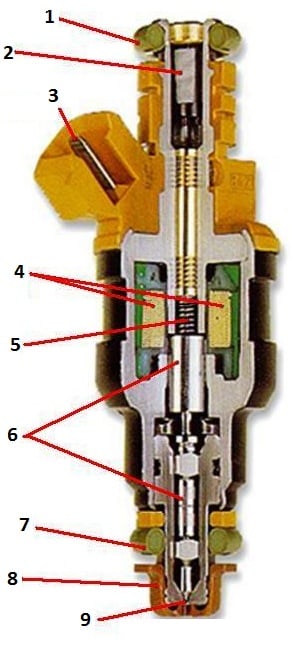
This spring pushes the pintle valve closed when the electrical signal stops. It ensures the injector shuts instantly to prevent over-fueling or dripping.
The pintle is a precision-ground metal rod that opens and closes the injector. Its movement allows fuel to flow—or blocks it. The shape of the pintle also influences the injector’s spray pattern, affecting combustion efficiency.
This lower seal ensures an airtight connection where the injector enters the intake manifold or combustion chamber. Worn or damaged O-rings can cause vacuum leaks, poor idle, or hard starts.
A small plastic or composite cap that surrounds the pintle tip. It helps stabilize spray direction and protects the delicate tip during installation. Cracked or missing pintle caps can cause uneven spray and misfires.
The exit point of the injector where fuel is atomized into a fine mist. The shape and size of the seat or nozzle directly influence the spray pattern. Deposits or damage here can drastically reduce injector performance and fuel efficiency.
Each part of a fuel injector must work in harmony to deliver the correct amount of fuel in the correct spray pattern—every time the engine fires. Even microscopic blockages or mechanical wear can cause significant issues like:
By understanding the internal structure of a fuel injector, you can:
Better interpret flow testing and cleaning results
Recognize symptoms of injector failure
Understand why ultrasonic cleaning and flow balancing are essential
Appreciate the level of precision required in today’s fuel delivery systems
At InjectorRx, our cleaning process addresses each of these components. We don’t just clean injectors—we inspect, test, and restore them to meet or exceed factory standards.